
AQUABATTERY wins Innovation Award vote
RenewaFLEXNL consortium kicks off major push to integrate long-duration energy storage into a smarter Dutch energy network
[Amsterdam, February 13 2026 ] - The Netherlands faces growing challenges in integrating renewable energy into its electricity system. Grid congestion, price volatility and the mismatch between variable generation and demand are limiting further electrification of industry, transport and horticulture. Long-Duration Energy Storage (LDES) is increasingly recognised as a key enabler for a reliable, affordable and sustainable energy system.
To address this, TNO is coordinating RenewaFLEXNL, a three-year project. This initiative brings together 17 partners from across the energy value chain - including technology developers, grid operators, renewable energy suppliers/developers and industrial users - to accelerate and de-risk LDES technologies and integrate them with renewable generation and energy offtakers.
“At AQUABATTERY, we believe that long-duration energy storage should be safe, scalable, and truly sustainable. Our saltwater-based acid–base flow battery demonstrates that it is possible to store clean energy from hours to days, reduce reliance on scarce materials, and provide industries and communities with reliable, low-carbon electricity." says Dr. Jiajun Cen, founder and CEO of AQUABATTERY.
He adds that "RenewaFLEXNL gives us the perfect platform to show how electrochemical storage with water and table salt can help the Netherlands transition to a resilient, renewable-powered energy system.”
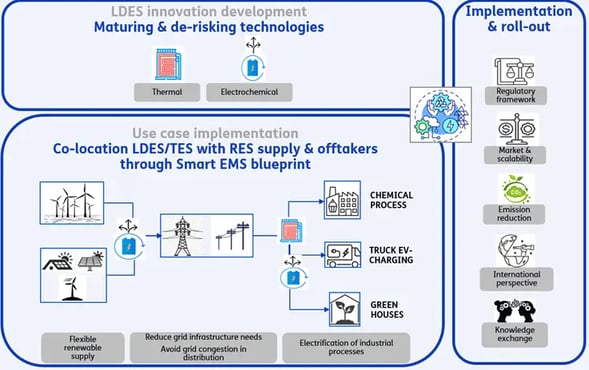
RenewaFLEXNL develops and validates three Dutch LDES solutions - covering electrical and thermal storage with 8–100 hour durations - tested alongside an open, modular Energy Management System (EMS) blueprint. The EMS and technologies will be applied in three real‑world cases that reflect Dutch system challenges:
- Rotterdam Harbour: integrating LDES with offshore wind to supply green power and clean heat to energy‑intensive industry.
- De Kwakel: supporting greenhouses with clean heat and power, reducing reliance on gas‑fired CHP.
- Altena: combining renewable generation, LDES, electric truck charging and heat for greenhouses and local offtakers.
These cases show how LDES can cut renewable curtailment, ease congestion and provide dependable, low‑carbon energy across the economy.
RenewaFLEXNL takes a holistic approach to system integration, delivering techno-economic assessments, life-cycle analyses, business case evaluations and regulatory recommendations. A national-level analysis will provide strategic guidance on where and how LDES can deliver the highest societal value, supporting grid operators, policymakers and market actors.
By the end of the project, RenewaFLEXNL will have laid the foundation for large-scale LDES deployment within the next decade, strengthening the resilience and affordability of the Dutch energy system.
TheRenewaFLEXNL consortium spans the full energy value chain. Partners include:
- Research and knowledge institutes: TNO (project coordinator), TU/e, DNV
- Renewable energy and energy companies: Vattenfall, Vopak, Nobian
- Grid operators: Stedin, with support of Enexis, Alliander and Tennet
- LDES technology developers: AQUABATTERY,ORE Energy, BB1 Project BV
- Industrial, horticultural and logistics users: Hilverda Florist, Butterfly Orchid
- Energy Trading Companies: Emmett Green, EFS
- Environmental and legal expertise: Ecomatters, New Ground Law
- Sector and system integration partners: Energy Storage NL


